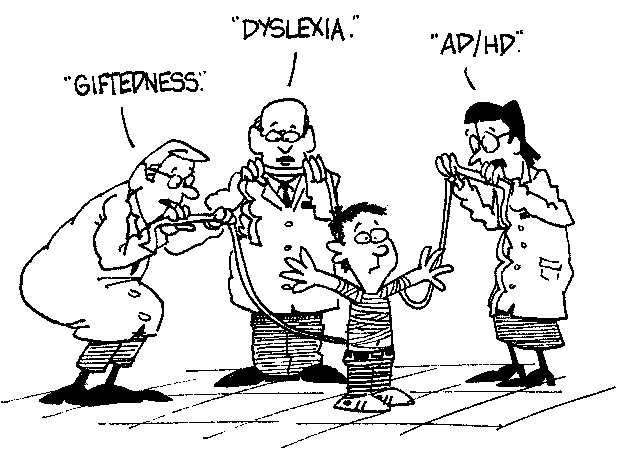
Some have called it the modern-day disease, others call it the age of electronics. Vaccinations have been blamed, Camel's milk has been recommended... Different names have been given including: ADHD, Attention Deficit Hyperactivity Disorder, ADD, AD/HD...
How many of you have heard of either or all of these acronyms/names?
I am not writing a post about all the details related to Attention Deficit Hyperactivity Disorder (ADHD)... at least not tonight. I would rather have us all think about what it actually means, and I hope to start breaking down the stigma associated with this particular learning difference. If you are interested to learn more, please look at the listed links at the bottom of the post.
First of all, I would like us to look at each individual component of the name: Attention, Deficit, Hyperactivity, Disorder. If we take each word as a piece of the challenge, we then need try to overcome that challenge by presenting a solution. This is my view of what the solution should be like:
A─ ATTENTION →→→→→→ ENGAGE & STIMULATE
D─ DEFICIT →→→→→→→ FEED
BODY & MIND
H─ HYPERACTIVE →→→→→→→
RELEASE
& REGULATE
D─ DISORDER →→→→→→→ ORGANIZE
& STRUCTURE
Attention: A child or adult with ADHD would benefit greatly from understanding what their learning style is, and by being engaged using multiple modalities and ways. As a parent, teacher or professional, one must help the child maintain attention by providing information visually, verbally and actively/concretely.
Deficit: As I have mentioned in previous posts, I am not a fan of complete elimination diets nor haphazard prescriptions (whether it is drugs or supplements). The process of dealing with ADHD, is usually a process of trial and error. We must try, through eliminations and inclusions to see what works best for our child. Always do full medical check-ups to see if your child has any medical conditions and any allergies/intolerances. After that we can start with decreasing the child's intake of unhealthy food habits (sweets, fried food, etc), increasing activity level, providing structure, educating ourselves and the child about the challenges, and also thinking about medication options.
Hyperactivity: It is critical to engage in physical activity. It is not only a release, but it is also vital that the person with ADHD has a positive attitude about his activity. S/he can be a great athlete, dancer, performer, and does not have to always be punished or criticized for his/her energy.
Disorder: Incorporate structure, discipline and routine into your life. Reminders are key!. Have visual reminders of the house/classroom rules and explain consequences to actions. Be a role-model yourself. Help your child organize his space, thoughts and actions.
I hope that by providing this small amount of information we can start thinking together about what ADHD really means. If you suspect that your child may be struggling, follow-up by having him/her assessed, and start teaching yourself about ADHD. You can also contact professionals in the field to help you through this process, as many parents request parenting skills training.
"Patient Voices", is a multimedia aspect of the New York Times that provides real-life stories of people who share a common medical or psychological condition. It is an EXCELLENT resource.
For more information here are some recommended websites:
For local support options:
- CCET: Call 1832000 for the national hotline provided by CCET! (working hours are 7am-5pm Sunday- Thursday). CCET also houses a brilliant library with updated books about learning difficulties/differences.
- KALD: A great resource in Kuwait.
- Soor Center- Call in for a consultation should you have any questions and concerns about assessments, parent-training and therapy.